We had just begun the adoption process and were looking forward to the day when we would welcome home our new daughters from Haiti . It was the very beginning of what would become a long, long journey but already The Question had been asked: "What about the hair?"
About that time, an African American friend was visiting in our home and she decided to give me my very first lesson in caring for black hair. She sat her daughter in front of us at the kitchen table and nimbly unraveled one of her braids.
"Go ahead," she said with a smile. "Give it a try!"
"A simple braid," I thought. "This is something I can do."
I divided the ponytail into three sections and began to weave them together the only way I knew how under her watchful eye. "Stop," she said a little sadly, "You're doing it wrong."
It was at that moment I first realized just how little I understood about African hair. I knew absolutely nothing at all.
The method most African Americans use for a simple braid differs from the one more commonly used by those of us of European descent. Instead of passing the two side strands over the center strand, one weaves them under it.
An easy way to tell which method you are using is to look at the position of your hands as you are braiding. If the palms of your hands are somewhat facing up, you are using the under-handed technique. If the backs of your hands are facing towards you as you braid, you are using the over-handed method.
Recently, I did an informal poll of a group of African American friends and only one of them had learned to braid over-handed. All of them agreed the under-handed technique forms a tighter braid that lasts longer than an over-handed braid.
If you are accustomed to the other method, this one will feel awkward at first but I promise you can do it with a little practice. I did!
Tools Needed:
- Spray bottle filled with warm water to coax free stubborn tangles.
- Pomade
- Rat-tail comb
- Wide tooth comb
- Ouchless Elastics
- Clips
- Boar Bristle Brush
 |
Step One
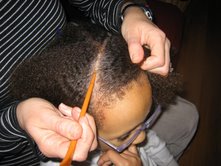
Begin with clean, detangled, and well moisturized hair. See the August 2007 Hair Matters article on Rainbow Kids.
Then, draw parts and divide your child's hair into sections, securing each section with a clip.See October 2007 Simple Part, and Two Strand Twist article on Rainbow Kids.
|
 |
Step Two
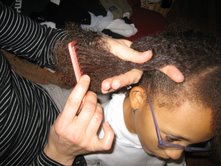
Work with one section of hair at a time. Add a bit of pomade and comb through with a wide tooth comb to ensure the hair remains tangle free as you work. This is important because hair that is tangled will form a messy braid .
|
 |
Step Three
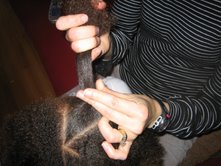
Gather the hair into a ponytail and secure close to the child's head with an elastic. Wrap the elastic around the hair several times until the ponytail is held firmly in place. Be careful to not pull the hair too tight. This is not only uncomfortable for your child but can actually irritate the scalp and cause hair loss.
|
 |
Step Four
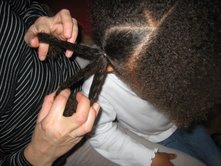
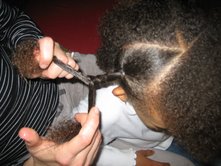
Now you are ready to form the braid. Divide the ponytail into three sections. Pay careful attention that the strands are as close to the same size as possible. Braids which have been divided unevenly will be badly proportioned and messy .
|
 |
Step Five
With the three strands of hair in your hands, take turns passing each of the side strands under the strand in the middle. This will weave the hair into a braid. Braid all the way down to the end as far as you can go. There will be no need for an elastic to keep the braid from unraveling. The curl on the end will do the job for you.
|
 |
Step Six
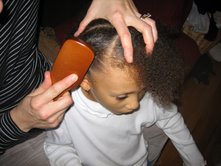
You may also smooth the edges of your daughter's hairline with a small touch of gel and a boar's hair brush. I sometimes skip this step because it is not essential but it gives the style a nice finishing touch. (You can also do this a couple of days later when the hair begins to frizz and it will prolong the style.)
|
 |
Step Seven
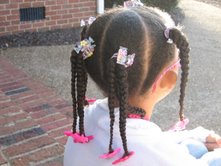
Repeat the process for each section of hair and you should have a hairstyle that will keep your little princess gorgeous for several days. Add colorful elastics at the top of each braid and inexpensive plastic barrettes to the ends to accessorize. Here is a final shot of our finished style.
|